By Ravish Handoo
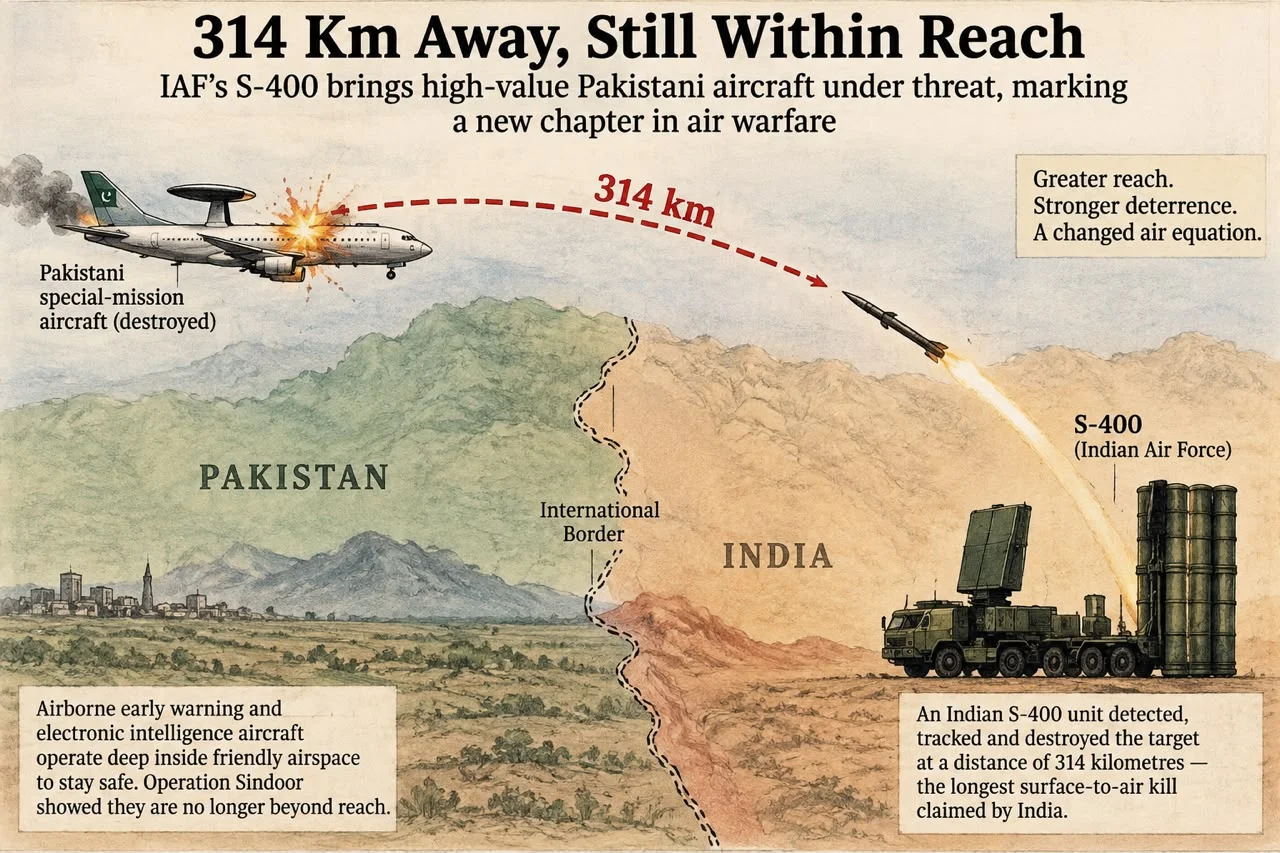
The disclosure that the Indian Air Force achieved a surface-to-air kill at a distance of 314 kilometres during Operation Sindoor is far more significant than the headline figure alone suggests. According to the Ministry of Defence’s account of the operation, an Indian S-400 air-defence unit detected, tracked and destroyed a Pakistani special-mission aircraft at an extraordinary distance of 314 kilometres. The engagement has been described by the ministry as the longest surface-to-air kill and provides one of the clearest indications yet of how the character of air warfare between India and Pakistan has changed. What makes the episode important is not merely the range of the missile involved, but the fact that a high-value aircraft operating hundreds of kilometres away could apparently be brought within the effective reach of India’s ground-based air defences.
The Ministry of Defence has described the aircraft destroyed in the engagement as a Pakistani “special-mission aircraft”. That terminology is important and should be retained when discussing the official account. Various reports and defence analyses have associated the incident with a Pakistani airborne early-warning or electronic-intelligence aircraft, including speculation about a Saab 2000-based platform. However, the official description should not automatically be expanded into an identification that the ministry itself has not explicitly made. Pakistan operates specialised airborne platforms that perform surveillance, early warning, command-and-control and electronic-intelligence functions. These aircraft are considerably more strategically valuable than ordinary combat aircraft because they function as airborne eyes and ears for a much larger force.
An airborne early-warning and control aircraft carries powerful radar and communications systems that allow it to monitor large areas of airspace. Flying at altitude gives its radar a wider field of view than most ground-based systems. It can detect aircraft, help establish the overall air picture, direct friendly fighters towards targets and assist commanders in coordinating complex operations. An electronic-intelligence aircraft can similarly monitor electromagnetic emissions, helping identify radar locations, communication patterns and other elements of an adversary’s electronic order of battle. Consequently, destroying one such aircraft can have an effect far greater than the loss of a single airframe.
This is what makes the reported 314-kilometre engagement strategically important. High-value aircraft such as airborne early-warning platforms are normally kept well behind the frontline. Their operators want them close enough to observe the battlespace but sufficiently distant from hostile fighters and surface-to-air missiles to remain protected. If an adversary demonstrates that these aircraft can be engaged at distances exceeding 300 kilometres, that calculation changes dramatically. The aircraft may have to operate farther away from the contested area, reducing the coverage they can provide and potentially weakening the support available to combat aircraft operating closer to the frontline.
The significance of the 314-kilometre figure therefore lies partly in the amount of Pakistani airspace that could potentially fall within the engagement envelope of an Indian long-range air-defence system positioned well inside Indian territory. The international border does not represent the beginning of the missile’s reach. If the launcher is positioned tens of kilometres inside India and its missile can engage a target hundreds of kilometres farther away, a considerable area beyond the border can become dangerous for hostile high-value aircraft. This creates a powerful area-denial effect. It is not necessary to fire at every aircraft entering that zone. Once an adversary knows that such an engagement is credible, it must alter its behaviour accordingly.
That psychological and operational effect is one of the most important characteristics of long-range air defence. A successful 314-kilometre engagement sends a message to opposing commanders that geographical depth by itself may no longer guarantee safety. An aircraft does not necessarily have to approach the border or enter Indian airspace to become vulnerable. The traditional assumption that strategic support aircraft can remain relatively safe by orbiting deep behind friendly territory becomes increasingly questionable when confronted with long-range surface-to-air systems.
The S-400 system is particularly relevant in this context. India acquired the Russian-origin S-400 Triumf to provide a long-range air-defence capability against a variety of aerial threats. The system is not simply a missile launcher. It consists of surveillance radars, engagement radars, command-and-control components and different categories of missiles intended for different targets and ranges. Its combat effectiveness depends on whether these elements can work together quickly enough to identify and engage a real target under wartime conditions.
That distinction matters because a missile’s advertised range does not automatically translate into a successful combat engagement at that distance. The defending force must first detect the aircraft, identify it correctly, maintain an accurate track and determine that it is hostile. The missile must then be launched with sufficiently precise information to intercept a moving target that may continue travelling for many kilometres while the weapon is in flight. At extreme ranges, even relatively small tracking errors can become significant. The engagement therefore demonstrates more than propulsion or missile reach; it indicates that India was able to generate an effective firing solution against a distant target.
This makes the reported 314-kilometre engagement an important operational milestone. A missile capable of flying that far is impressive on paper, but using it successfully against an operational aircraft is considerably more demanding. Combat introduces electronic interference, imperfect intelligence, human decision-making, target manoeuvres and an enemy actively attempting to survive. The Ministry’s account suggests that the system was able to overcome those complications during Operation Sindoor.
If the target was indeed performing an airborne surveillance or electronic-intelligence role, the engagement becomes particularly significant because the aircraft itself would have been central to Pakistan’s understanding of the air battle. An airborne early-warning aircraft is not merely another plane in the formation. It acts as a force multiplier, providing information to fighters and commanders across a wide area. Its removal can force greater dependence on ground-based radars and individual fighter sensors, both of which have limitations.
The destruction of a special-mission aircraft also carries consequences disproportionate to the number of aircraft lost. Pakistan possesses a finite fleet of airborne early-warning and specialised surveillance platforms. Such aircraft are expensive, technologically complex and difficult to replace quickly. Their crews are also highly trained. Losing one therefore represents not merely the destruction of hardware but potentially the loss of a scarce operational capability.
The most immediate response to such a demonstrated threat would be to move similar aircraft farther from the engagement zone. That improves their survivability but can reduce their usefulness. Radar performance is governed partly by geometry. The curvature of the Earth limits how far radar can see low-altitude targets, and while airborne radar gains a major advantage from altitude, increasing its distance from the area being monitored can still reduce the quality of coverage. The farther the aircraft is forced from the battlefield, the more difficult it may become to provide the same level of support to fighters operating near the contested region.
The resulting operational effect can spread through an entire force. If an airborne early-warning aircraft has to remain farther away, its coverage of the contested airspace may decline. Fighters may receive less timely warning of approaching threats or may have to depend more heavily on their own onboard sensors. That can reduce situational awareness and increase pilot workload. The value of destroying or displacing one specialised platform can therefore exceed the value of destroying several ordinary aircraft.
This is one reason modern air forces increasingly seek to attack an opponent’s surveillance and command assets rather than focusing only on fighters. An adversary with twenty fighters supported by effective airborne surveillance can be much more capable than an adversary with the same twenty fighters operating with degraded situational awareness. Reducing the effectiveness of early-warning and command systems can therefore weaken an entire air operation without the need to destroy every combat aircraft individually.
Operation Sindoor appears to illustrate this broader approach. India’s reported actions during the confrontation were not limited to defensive interception. Pakistani military infrastructure, radar installations, air-defence positions, command-and-control facilities, runways and aircraft-related infrastructure were among the categories of targets reportedly struck during the operation. This suggests that the objective was not simply to intercept incoming threats but also to reduce Pakistan’s ability to generate, coordinate and sustain air operations.
The distinction is fundamental. A fighter aircraft may remain physically intact, but its usefulness can decline if its supporting radar picture is degraded, communications are disrupted, air bases are damaged or command centres are unable to coordinate operations effectively. By striking multiple components of the opposing air system, an air force can create cumulative disruption that is greater than the effect of any single strike.
The reported attacks on radar and command infrastructure are especially relevant when considered alongside the 314-kilometre engagement. If Pakistani ground-based surveillance was under pressure, airborne early-warning aircraft would have become even more important. That in turn would make them highly attractive targets. In such a scenario, the destruction of a special-mission aircraft would not be an isolated event but part of a broader effort to reduce the adversary’s awareness of the battlespace.
The implications are serious because situational awareness is central to modern air combat. A fighter that detects an opponent first has a better chance of positioning itself advantageously and firing first. An air force that sees an incoming raid earlier has more time to scramble aircraft, activate air defences and protect vulnerable assets. Conversely, a force operating with incomplete information has less time to react and may be forced into more conservative tactics.
The S-400’s role in such an environment extends beyond the actual launch of missiles. Its presence can force the enemy to reconsider where important aircraft operate, which routes they use and how close they can safely approach the contested region. This produces a deterrent effect even when no shot is fired. A weapon system that alters enemy behaviour is already shaping the battlespace.
The same logic applies to aircraft other than airborne early-warning platforms. Aerial refuelling tankers, electronic-warfare aircraft, reconnaissance platforms and transport aircraft are all valuable support assets. They tend to be larger, less manoeuvrable and more vulnerable than fighters. A credible 300-kilometre-plus surface-to-air threat can therefore force several categories of aircraft to remain farther from the area of operations.
Tankers are a particularly useful example. Fighters operating at extended ranges depend on aerial refuelling to remain airborne for longer periods. If tankers are forced to orbit much farther from the frontline, fighters must travel greater distances to refuel and may spend less time on station. This can reduce persistence and complicate mission planning. A long-range air-defence system can therefore influence combat aviation indirectly by threatening the support structure that sustains it.
Electronic-intelligence and electronic-warfare aircraft face similar problems. These platforms often need to operate at positions from which they can monitor hostile emissions or interfere with enemy systems. Pushing them farther away can reduce the effectiveness of their missions. Again, the important effect is not simply destruction but displacement.
This is where the concept of strategic depth becomes increasingly important. Pakistan has traditionally been able to position some valuable assets away from the immediate border and thereby reduce their exposure. Long-range precision weapons and air-defence systems are eroding the protection historically provided by distance. An aircraft or military facility may be hundreds of kilometres from the border and still remain within reach of modern weapons.
Operation Sindoor therefore points towards a broader transformation in the India-Pakistan military equation. The confrontation was not simply about how many fighter aircraft each side possessed. It highlighted the growing importance of detection range, missile reach, precision strike, electronic warfare, command resilience and the survivability of specialised platforms. The side that can preserve its own critical assets while forcing the opponent’s farther from the battlespace gains an important operational advantage.
The 314-kilometre engagement should also be assessed as a combat validation of the S-400. Weapons manufacturers routinely publish impressive specifications for missile range, radar detection and target capacity. Those specifications are useful but do not fully represent wartime performance. Real combat introduces uncertainty, electronic countermeasures, incomplete information, operational pressure and an enemy that actively seeks to avoid destruction. A successful interception under such conditions provides evidence that cannot be replicated fully on a controlled test range.
There is nevertheless a need for caution when interpreting the phrase “longest surface-to-air kill”. Military records are difficult to establish conclusively. Many countries do not publicly disclose the exact circumstances or ranges of wartime missile engagements, and some information remains classified for decades. The Ministry of Defence’s description establishes India’s official claim regarding the engagement, but independently declaring it the undisputed longest surface-to-air kill in all military history would require access to information that is unlikely to be fully public. The safest formulation is therefore that the Indian Ministry of Defence has described the 314-kilometre engagement as the longest surface-to-air kill.
There is another distinction that deserves attention. Reports concerning Operation Sindoor have referred both to aircraft destroyed in the air and aircraft or airborne assets damaged or destroyed while located at Pakistani air bases. These should not automatically be treated as the same events. An airborne aircraft destroyed by an S-400 at 314 kilometres represents a very different type of engagement from an aircraft destroyed inside a hangar by a stand-off strike. Both may carry strategic significance, but the circumstances and implications are different.
The 314-kilometre engagement is particularly consequential because it represents the projection of defensive firepower over enormous distance without requiring Indian fighter aircraft to physically enter that airspace. This complicates the conventional distinction between offensive and defensive capability. An S-400 battery positioned inside Indian territory is fundamentally an air-defence system, yet its engagement envelope can extend deep beyond the border. In practical terms, it can influence hostile air operations in areas that would traditionally have been considered part of the adversary’s rear.
That does not mean every aircraft inside the theoretical engagement radius can automatically be destroyed. Terrain, target altitude, radar geometry, electronic warfare, missile availability and rules of engagement all affect the outcome. However, once a successful interception has occurred at 314 kilometres, the adversary must treat at least part of that threat envelope as operationally credible.
For Pakistan, the most immediate concern is therefore not simply the replacement of whatever aircraft was lost. Its planners must account for the possibility that future airborne early-warning, intelligence and other support aircraft could be vulnerable at ranges previously considered comparatively safe. Patrol areas may need to be changed. Aircraft may have to operate at greater distance. Electronic-warfare support may need to be strengthened. More attention may have to be devoted to locating and suppressing Indian long-range air-defence batteries.
That last point is particularly important because the S-400 itself becomes a high-priority target once its effectiveness is demonstrated. An adversary will attempt to identify its location using reconnaissance, drones, electronic intelligence and other means. Once located, the battery may be targeted with stand-off weapons or subjected to electronic attack. This means the survivability of the system depends not only on the capability of its missiles but also on camouflage, mobility, deception and supporting defences.
Mobility is central to the survival of such systems. A battery that remains permanently in one known location can eventually become vulnerable to precision targeting. By moving between prepared positions, reducing unnecessary radar emissions and employing decoys, air-defence operators can make targeting far more difficult. The uncertainty surrounding the exact location of a long-range system may itself force the enemy to allocate more resources to reconnaissance and suppression.
Operation Sindoor also demonstrates how offensive and defensive operations can reinforce one another. India reportedly used stand-off weapons to attack Pakistani military infrastructure while its air-defence network protected Indian territory and threatened Pakistani aircraft. Offensive strikes can reduce the enemy’s ability to retaliate, while defensive systems can protect the force conducting those strikes. The interaction between the two can produce cumulative pressure.
Attacking enemy radars can reduce warning time. Striking command centres can disrupt coordination. Damaging runways can restrict aircraft operations. Destroying specialised aircraft can weaken surveillance. Suppressing surface-to-air missile sites can make further strikes easier. None of these actions needs to be decisive individually. Their combined effect is what matters.
This is also why the 314-kilometre engagement should not be reduced to a simple comparison of missile ranges. The important operational question is whether the capability can be repeated consistently. One successful engagement demonstrates potential, but sustained advantage requires trained crews, reliable logistics, secure communications, adequate missile stocks and the ability to keep the batteries operational under enemy attack.
Pakistan will inevitably study the engagement closely. Its planners will seek to determine how the aircraft was detected, what warning signs preceded the missile launch and whether future missions can be conducted outside the effective engagement zone. Possible responses include altering patrol patterns, flying at different altitudes, increasing jamming, using decoys, improving electronic intelligence or attempting to destroy the air-defence battery itself.
This illustrates a basic feature of military competition: every demonstrated capability generates an effort to counter it. India may have gained an important operational advantage, but that advantage will not remain static. Pakistan will adapt its tactics and technologies, and India will have to adapt again in response. The long-term value of the 314-kilometre engagement therefore lies not merely in the record it may have set but in the doctrinal lessons it provides.
The episode is also relevant to India’s future force structure. Operation Sindoor strengthens the argument for continued investment in long-range air defence, indigenous missile systems, electronic warfare, resilient communications and integrated surveillance. The S-400 provides an important capability, but India cannot depend indefinitely on one imported platform. A sustainable air-defence architecture requires domestic development, multiple layers of weapons and sufficient production capacity to replace missiles expended in wartime.
The threat environment is also becoming more diverse. Modern air defence must deal not only with fighters and large aircraft but also with cruise missiles, ballistic missiles, unmanned aircraft and inexpensive drones. Using a highly sophisticated long-range interceptor against a small, low-cost drone would often be economically irrational. Different threats therefore require different defensive tools.
At one end of the spectrum are inexpensive drones that may be better countered through electronic warfare, guns or short-range missiles. At the other end are high-value aircraft whose destruction can have strategic consequences. A special-mission aircraft falls firmly into the latter category. If the target of the 314-kilometre engagement was indeed an airborne surveillance or command platform, the expenditure of a sophisticated long-range interceptor would be justified by the value of the target and the operational consequences of removing it.
This cost-exchange logic is becoming increasingly important in modern warfare. Air-defence commanders must decide not only whether a target can be destroyed but whether it should be engaged with a particular weapon. Missile inventories are finite, and long-range interceptors are expensive. Preserving them for the most valuable targets can be critical during a prolonged conflict.
The wider geopolitical significance of the engagement lies in the gradual erosion of sanctuary. For much of military history, geographical distance provided a measure of protection. Headquarters, air bases and support aircraft were positioned behind the frontline because enemy weapons could not easily reach them. Long-range precision weapons have steadily reduced that protection, and long-range air defence is now doing something similar in the aerial domain.
An aircraft hundreds of kilometres from the border may still be part of the immediate battlespace. A radar located far behind the frontline may influence events at the border. A missile battery positioned inside its own territory may affect how an adversary operates deep inside its airspace. The physical border therefore becomes only one reference point among several. The more important boundaries are increasingly defined by the reach of sensors and weapons.
Seen from this perspective, the reported 314-kilometre engagement is not merely an extraordinary statistic from Operation Sindoor. It is a glimpse of how a future India-Pakistan air confrontation could unfold. High-value support aircraft may be forced to operate farther away. Air bases and command centres may face long-range precision attack. Surface-to-air missile systems may become priority targets in their own right. The contest will revolve around preserving freedom of action while denying it to the adversary.
For Pakistan, the implications are particularly serious if the engagement involved an airborne early-warning aircraft. Such platforms are central to extending radar coverage and coordinating fighter operations. If they can no longer operate comfortably at previously used distances, Pakistan may have to rethink how it provides airborne surveillance during a high-intensity confrontation.
For India, the episode demonstrates the potential value of long-range air defence not only as a shield but also as a means of shaping enemy behaviour. A system capable of reaching hundreds of kilometres beyond the immediate border can force an adversary to move valuable assets, change tactics and devote additional resources to suppression. The effect therefore extends well beyond the aircraft actually destroyed.
At the same time, the precise details of the engagement remain important. The location of the S-400 battery, the position and altitude of the target, the missile variant used and the exact role of the Pakistani aircraft have not all been publicly established in the Ministry’s official description. Without those details, attempts to reconstruct the interception precisely should be treated as analysis rather than confirmed fact.
The strongest publicly established point is that the Ministry of Defence says an Indian S-400 unit destroyed a Pakistani special-mission aircraft at a range of 314 kilometres during Operation Sindoor. That claim alone is significant. It indicates that the reach of Indian air defence extended far beyond the immediate border and that a high-value Pakistani airborne asset could be engaged at exceptional distance.
The deeper importance of the episode lies in what it says about the changing meaning of strategic depth. Distance is becoming less reliable as a form of protection. Aircraft operating far from the frontline, radars positioned deep inside national territory and command centres located well behind forward positions can all be threatened by long-range systems. The battlespace is expanding.
In that environment, the survival of high-value assets depends increasingly on mobility, deception, electronic protection and tactical unpredictability. Simply moving farther from the border may no longer be sufficient. An aircraft or radar must also consider whether it can be detected, whether its emissions reveal its location and whether hostile weapons can reach it before it can react.
Operation Sindoor therefore appears to mark a significant evolution in the India-Pakistan air equation. The 314-kilometre engagement suggests that the conflict was not confined to the immediate border region but extended deep into the operational space behind it. It also shows why high-value support aircraft are becoming increasingly vulnerable as long-range air-defence systems improve.
The episode ultimately matters because it transforms a theoretical capability into an operational precedent. Before such an engagement occurs, commanders may debate how far a long-range system can realistically reach in combat. After a successful kill at 314 kilometres, that uncertainty changes. The opposing side must plan on the assumption that the threat is real.
That can have consequences long after the original engagement. Future Pakistani aircrews may fly different routes. Commanders may place greater emphasis on electronic protection. Airborne surveillance aircraft may remain farther from the contested region. More resources may be devoted to finding and suppressing Indian long-range air defences. In this sense, the effect of the 314-kilometre kill could continue even if an engagement at that distance is never repeated.
The headline from Operation Sindoor is therefore straightforward: India says its S-400 destroyed a Pakistani special-mission aircraft from 314 kilometres away. The strategic meaning is broader. The engagement suggests that geographical depth alone can no longer be assumed to protect valuable airborne assets and that India possesses the ability to impose risk far beyond its immediate airspace.
If that capability can be sustained, protected against countermeasures and supplemented by indigenous systems, it could substantially alter the operational geography of future confrontations. Pakistan would have to account for a much wider zone of vulnerability for its airborne surveillance and support assets, while India would gain greater ability to restrict hostile air operations without relying solely on fighter penetration.
The most important legacy of the 314-kilometre engagement may therefore be its effect on planning rather than its place in the record books. It demonstrates that an aircraft operating hundreds of kilometres away can still fall within the lethal reach of modern air defence. That reality changes how both sides must think about distance, survivability and the location of high-value assets in any future conflict.