Centenary event in Leh highlights national unity and inclusiveness amid months of reported alienation; Dr. Manmohan Vaidya emphasises Panch Parivartan, character-building, civilisational awareness, indigenous capabilities and service to Bharat
Leh: A wave of nationalism and patriotism was witnessed in Ladakh during an RSS event organised as part of its centenary celebrations. The programme highlighted the Rashtriya Swayamsevak Sangh’s emphasis on national unity and inclusiveness in the cold desert, following months of reported alienation, bringing the organisation’s century-long journey of social service and nation-building into focus at a time when questions of regional identity, social cohesion and Ladakh’s relationship with the wider national framework have remained prominent in public discourse.
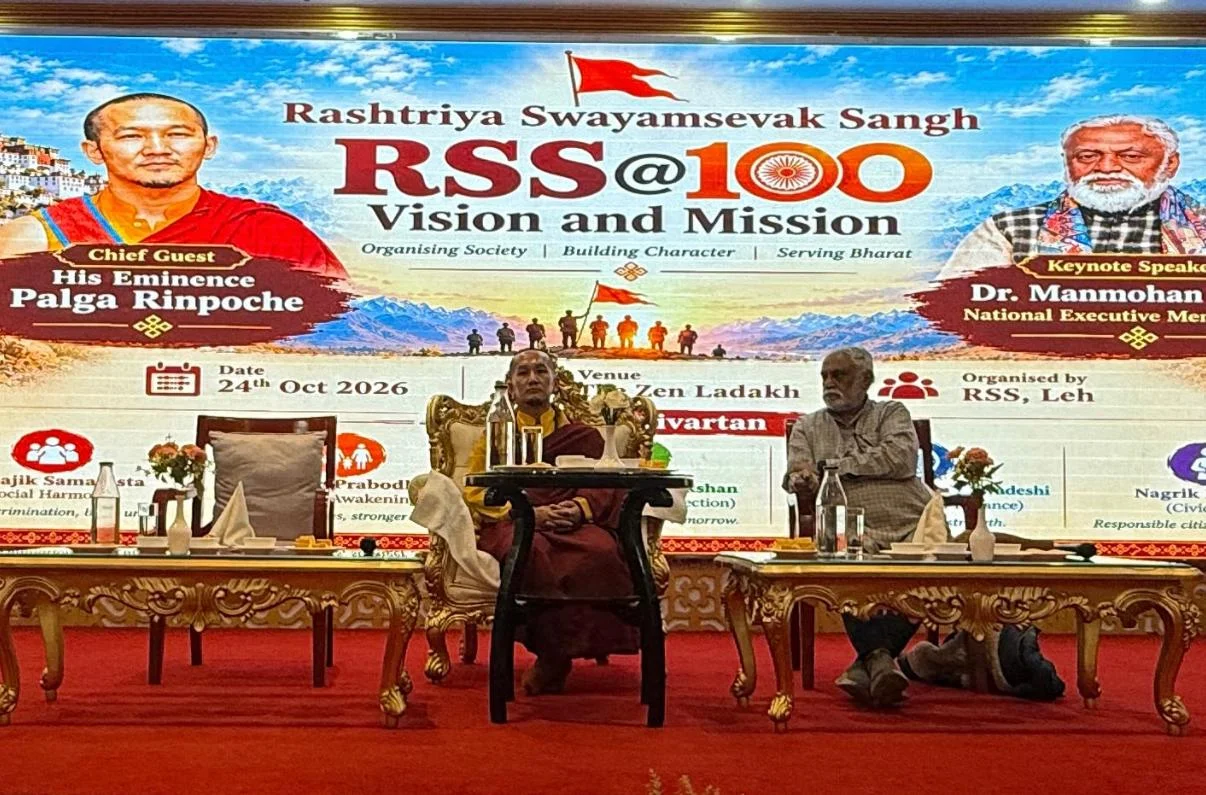
The event, titled “RSS@100: Vision and Mission — Organising Society, Building Character, Serving Bharat,” was organised in Leh on October 24 to mark the completion of 100 years of the Rashtriya Swayamsevak Sangh (RSS). The programme brought together discussions on Bharat’s civilisational heritage, national consciousness, cultural values, character-building, social harmony and the collective responsibility of citizens in the process of nation-building.
Dr. Manmohan Vaidya, National Executive Member of the RSS, delivered the keynote address, placing particular emphasis on Panch Parivartan, or the Five Transformations, and the need to connect individual character with wider social change. His address linked patriotism with practical responsibility, arguing for a national commitment reflected in conduct, service, respect for others and contributions to collective well-being.
His Eminence Palga Rinpoche, who attended as the chief guest, spoke about nation-building, Bharat’s ancient civilisation and the importance of cultivating respect for the nation and its cultural values. He also highlighted the sacrifices of Indian Army personnel in protecting the country and appreciated the RSS’s century-long journey of service to society and the nation.
The programme was introduced by Padma Shri Dr. Padma Gurmeet, Vibhag Sanghchalak, Ladakh Vibhag, while Dr. Dawa Wangmo, Assistant Professor in the Department of International Relations at the University of Ladakh, moderated the proceedings.
The centenary gathering was framed around three interconnected ideas: organising society, building character and serving Bharat. Together, these themes provided the basis for a broader discussion on how individuals, families, communities and institutions can contribute to national development while preserving cultural heritage, strengthening social relationships and preparing younger generations for future challenges.
The programme also brought national unity into focus through discussions on civilisational continuity, indigenous knowledge, women’s contributions, respect for the armed forces and the importance of social cooperation. The message was that national consciousness must be accompanied by a sense of responsibility towards society and an appreciation of the cultural traditions and experiences that shape communities.
The completion of 100 years of the RSS provided the central occasion for the Leh programme, offering an opportunity to reflect on the organisation’s stated vision, mission and journey of service, as well as the continuing relevance of social organisation in contemporary India.
The centenary theme, “Organising Society, Building Character, Serving Bharat,” placed social responsibility at the heart of the deliberations. Rather than treating these three ideas as separate objectives, the programme presented them as interconnected dimensions of national development.
Organising society, as discussed during the programme, involves developing collective responsibility, strengthening relationships among communities and encouraging individuals to recognise their role within the wider social environment. A society capable of working towards common objectives depends on cooperation, mutual respect and the willingness of its members to contribute beyond their immediate interests.
Character-building, meanwhile, concerns the cultivation of values that guide individual conduct. Integrity, discipline, honesty, accountability, respect and concern for others were among the qualities highlighted in the wider discussions. These values were presented as important foundations for responsible citizenship and constructive participation in public life.
The third component, service to Bharat, connects individual and collective responsibilities with the welfare of the nation. Service was discussed in a broad sense, extending beyond formal programmes or organised voluntary activities to include professional responsibility, educational development, community assistance, cultural preservation and everyday efforts to improve the circumstances of others.
The programme emphasised that national development cannot be measured exclusively through economic growth, infrastructure or institutional progress. It also depends on the quality of relationships among citizens, the ethical foundations of public life, respect for cultural traditions and the willingness of individuals to act responsibly towards society.
The centenary was therefore presented not merely as a historical milestone but as an occasion to examine how an organisation’s guiding principles relate to contemporary challenges and responsibilities. The discussions encouraged participants to consider how values associated with discipline, social cooperation and service could find expression in practical action.

A century-long institutional journey also provides an opportunity to consider the importance of continuity and adaptation. Social organisations operate within changing circumstances, and sustained work requires commitment, organisation, cooperation and the capacity to respond to emerging needs.
The programme recognised the RSS’s contribution to social service and nation-building while placing its centenary themes within the wider context of cultural awareness, civic participation and the aspirations of future generations.
Dr. Manmohan Vaidya’s keynote address was one of the central components of the programme, with Panch Parivartan emerging as a principal theme of his message.
The concept of Five Transformations provided a framework for discussing the relationship between individual behaviour, social relationships, cultural awareness and collective responsibility. The address emphasised that meaningful social transformation requires more than declarations of intent. It depends on the willingness of individuals to examine their conduct, fulfil their responsibilities and contribute constructively to their communities.
The keynote placed character-building at the centre of this process. Personal values influence the way people make decisions, interact with others and respond to competing interests. When integrity, discipline and responsibility become part of everyday conduct, they can help strengthen social trust and cooperation.
Dr. Vaidya’s message connected personal development with the wider process of nation-building, highlighting the idea that individuals are not merely observers of social change. Their actions and attitudes help shape the expectations, relationships and practices that influence the character of their communities.
The discussion also highlighted the importance of social harmony. A harmonious society is not necessarily one without disagreements or differences. Rather, it is one in which people can maintain respectful relationships, recognise the dignity of others and address differences through constructive engagement.

In a diverse country such as Bharat, social cohesion requires an appreciation of the experiences, traditions and perspectives of different communities. Mutual respect and a willingness to understand others can help prevent misunderstandings and strengthen relationships across social boundaries.
The keynote further emphasised collective responsibility, drawing attention to the roles played by families, educational institutions, community organisations and public institutions in shaping social life. Each has different responsibilities, but their contributions can complement one another in creating an environment that supports ethical conduct, cooperation and public participation.
The significance of Panch Parivartan, in the context of the programme, lay in connecting these different dimensions of social development. Individual transformation was presented as an important foundation for broader social change, while cooperation and shared responsibility were highlighted as necessary conditions for sustained progress.
The message also carried an emphasis on participation. Individuals can contribute to their communities through responsible professional conduct, educational initiatives, assistance to vulnerable people, preservation of cultural knowledge, protection of shared resources and involvement in local problem-solving.
Such contributions may not always attract public attention, but their cumulative effect can influence the quality of social relationships and the effectiveness of institutions.
The keynote thus connected the idea of national commitment with the practical responsibilities of citizenship, stressing that a stronger society depends on the conduct and contributions of its members.
One of the prominent messages highlighted during Dr. Vaidya’s address was “Bharat ko maano, phir jaano” — recognise Bharat and then understand it.
The expression placed national consciousness and historical understanding at the centre of the discussion, encouraging citizens to develop an informed appreciation of the country’s civilisational heritage, cultural traditions, achievements and social realities.
The message drew attention to the relationship between national identity and knowledge. Recognising the significance of a country, the programme suggested, should encourage people to learn about its history, understand its institutions, appreciate its cultural diversity and examine the experiences that have shaped its development.
Such understanding requires more than sentiment alone. It involves learning, inquiry, reflection and engagement with the complexity of history. An informed appreciation of Bharat includes recognising the contributions of different regions and communities, understanding historical transformations and studying the challenges that have influenced the country’s social and economic development.
Education, research, reading, cultural exchange and engagement with local histories were among the ways through which such understanding could be deepened. The knowledge of older generations, documentation of community experiences and preservation of historical sites and cultural practices can also contribute to a more comprehensive understanding of the past.
For younger citizens, the message was particularly relevant because historical and cultural awareness can help them understand their place within the wider national community while developing the knowledge and skills required to participate in contemporary society.
The programme’s discussions also placed national consciousness alongside responsibility. Understanding the country’s heritage becomes more meaningful when it encourages people to contribute to its progress, appreciate the diversity of its communities and act with concern for the well-being of fellow citizens.
In the context of the RSS centenary, the message reinforced the organisation’s stated emphasis on connecting cultural awareness with social responsibility and service.
The programme also highlighted the importance of studying Bharat’s civilisational heritage with seriousness and an appreciation of the different traditions that have shaped its history. The country’s cultural landscape encompasses a wide variety of linguistic, philosophical, artistic, regional and social experiences, reflecting centuries of interaction, exchange and continuity.
Understanding this inheritance requires recognising both shared foundations and the diversity within them. The discussions encouraged participants to consider how historical awareness can contribute to contemporary responsibilities, including education, cultural preservation and constructive participation in public life.
Another important element of Dr. Vaidya’s keynote was the call to express national commitment through action.
The address highlighted the distinction between expressing ideals and implementing them in everyday life. National commitment, according to the message conveyed during the programme, acquires practical meaning when it influences the way people fulfil their professional duties, interact with others, respect public property, support community welfare and contribute to constructive social change.
Responsible citizenship can be expressed in different ways. Teachers and researchers can contribute through education and the development of knowledge. Health workers support public well-being, while administrators have responsibilities in the delivery of public services. Farmers, workers, entrepreneurs and professionals contribute through their skills and productive efforts, while community members help maintain social relationships and support local initiatives.
These forms of contribution differ in nature, but they can share common values of dedication, integrity, discipline and concern for others.
The keynote also drew upon the spirit of the patriotic expression “Saare Jahan Se Achha, Hindustan Hamara” to convey a message about the responsibility associated with belonging to the nation.
Dr. Vaidya encouraged people not merely to be birds in Bharat’s garden, but to become plants that nurture, protect and sustain it. The imagery highlighted the difference between simply enjoying the benefits of belonging to a national community and actively contributing to its well-being.
The garden represented a shared national space, while the imagery of plants suggested sustained participation, care and long-term commitment. The message connected patriotism with the responsibility to nurture institutions, protect cultural heritage, strengthen communities and contribute to the welfare of future generations.
It also highlighted the importance of intergenerational responsibility. Every generation inherits cultural traditions, institutions, natural resources and social relationships from those who came before it. It carries a corresponding responsibility to preserve and improve these resources for those who will follow.
The programme’s emphasis on action therefore extended beyond symbolic expressions of national pride. It called attention to the everyday choices and responsibilities through which citizens can contribute to the development of a stronger and more cohesive society.
The wider message was that national progress depends on the interaction between individual initiative and collective effort. When citizens act constructively and recognise their responsibilities towards others, they can help strengthen the institutions and relationships on which society depends.
His Eminence Palga Rinpoche, the chief guest, addressed the gathering on nation-building, the importance of understanding Bharat’s ancient civilisation and the need to cultivate deep respect for the nation and its cultural values.
His address emphasised that understanding a country requires more than familiarity with geographical boundaries or political institutions. It also involves recognising historical experiences, cultural traditions, philosophical contributions and the values through which communities have understood their relationships with one another and the wider world.
Bharat’s civilisational heritage, as discussed during the programme, encompasses a long history of intellectual inquiry, cultural expression, philosophical reflection and diverse traditions of community life. Its development has been shaped by different regions, languages, communities and experiences.
The address highlighted the importance of preserving and understanding this inheritance. Cultural awareness can strengthen responsibility towards society when it encourages people to learn from history, preserve valuable traditions and contribute positively to the future.
Such awareness also requires an appreciation of the diversity of experiences and communities that form part of the country’s wider civilisational story.
For Ladakh, the discussion carries a distinctive regional context. The region has its own historical experiences, cultural traditions, local knowledge systems and community practices. Its heritage includes traditions of learning, craftsmanship, architecture, community cooperation and cultural expression.
Preserving this inheritance requires participation by local communities, educational institutions, cultural organisations and younger generations. It involves maintaining languages, documenting local histories, supporting traditional skills and helping young people understand the significance of their cultural environment.
The programme encouraged participants to view cultural preservation not merely as the retention of historical objects or the performance of traditional practices on special occasions, but as an ongoing responsibility involving the transmission of knowledge and experience across generations.
At the same time, the discussions recognised that cultural awareness can contribute to contemporary development. Understanding the past can provide a foundation for evaluating new ideas, responding to emerging challenges and developing solutions suited to local circumstances.
The programme’s wider emphasis was that respect for heritage and commitment to future development need not be contradictory. Historical knowledge can provide perspective and confidence, while education, research and innovation can help ensure that cultural knowledge remains relevant and accessible to future generations.
A prominent aspect of Palga Rinpoche’s address was the recognition of the sacrifices and dedication of Indian Army personnel in safeguarding the nation and its people.
He highlighted the importance of acknowledging the service rendered by members of the armed forces, whose responsibilities include protecting the country’s territorial integrity and responding to demanding circumstances in the service of national security.
The subject carries particular resonance in Ladakh, where high-altitude terrain, harsh climatic conditions and proximity to sensitive border areas make national security and the dedication of security personnel especially important.
Military personnel operating in such environments face geographical and climatic challenges that require discipline, training, professionalism and sustained readiness. Their responsibilities may also involve prolonged periods away from their families and the uncertainties associated with service in difficult conditions.
The programme’s discussion of national service extended to the families and communities connected with those who serve. The sacrifices associated with military responsibilities are not borne by personnel alone; families and loved ones also share the challenges and uncertainties of such service.
Respect for the armed forces, as reflected in the programme, can be expressed through public appreciation, responsible citizenship, concern for service personnel and their families, and a commitment to the social cohesion that strengthens the country.
The recognition of the armed forces also connected with the programme’s wider discussion of service. While civilian responsibilities differ from military duties, citizens across professions can contribute to national development through their own work, skills, knowledge and community participation.
Teachers educate future generations, researchers develop knowledge, health workers support public welfare, administrators deliver essential services, and workers and farmers sustain economic activity. Community members also contribute through cooperation, local initiatives and the maintenance of social relationships.
The programme thus brought together appreciation for the armed forces and recognition of the RSS’s century-long journey of service as different subjects within the broader discussion of dedication to collective well-being.
Dr. Vaidya’s keynote also addressed Bharat’s historical economic strength and the importance of indigenous skills, connecting civilisational heritage with productive capabilities and future development.
The discussion drew attention to the knowledge traditions and practical skills through which communities have organised production, developed crafts, exchanged goods and adapted to changing conditions.
Bharat’s economic history encompasses traditions of agriculture, craftsmanship, trade, textiles, metalworking, architecture and other productive activities. These have formed important parts of the economic and cultural life of different regions.
Indigenous capabilities represent accumulated knowledge and practical experience developed within particular social and geographical environments. Traditional skills often reflect an understanding of materials, local resources, environmental conditions and community needs.
Recognising these capabilities involves documenting valuable knowledge, understanding its significance and identifying ways in which relevant skills can be sustained, adapted and combined with contemporary technologies.
For Ladakh, local knowledge is closely connected with the natural environment, traditional livelihoods, craftsmanship and the management of limited resources. The region’s distinctive geographical conditions have influenced the ways in which communities have developed practices suited to their surroundings.
Understanding and preserving these capabilities can contribute to cultural continuity while creating opportunities for appropriate innovation. Indigenous skills may also support economic participation when connected with education, training, entrepreneurship, market access and sustainable livelihood opportunities.
Traditional craftsmanship and local knowledge can offer possibilities for younger generations when the conditions for learning and productive activity are strengthened.
The programme’s discussion of historical economic strength therefore encouraged reflection on the relationship between heritage and future development. Knowledge of the past can help identify skills and capabilities deserving of attention, while contemporary research and innovation can provide new ways to apply them.
The wider message was that national development benefits from an appreciation of historical achievements alongside an understanding of present-day opportunities. Building a capable and self-reliant society requires investment in knowledge, education, skills, creativity and productive participation.
The contribution of women was another important subject addressed by Dr. Vaidya during the keynote. The programme highlighted the significance of women’s participation in the social, cultural, economic, educational and public life of Bharat, emphasising the need to recognise their contributions as an integral part of the country’s historical experience and contemporary development.
Women contribute across a wide range of fields, including education, research, agriculture, entrepreneurship, public administration, community leadership, professional work, cultural preservation and family responsibilities. These roles are diverse and often interconnected, influencing household well-being and wider social development.
Recognising women’s contributions involves more than general expressions of appreciation. It also requires understanding the opportunities and challenges that shape their participation in different spheres of life.
Access to education, professional training, economic resources, leadership opportunities and safe working environments can influence the extent to which women are able to realise their potential. The programme also highlighted women’s role in transmitting cultural knowledge and maintaining community traditions. In many regions, women contribute to the preservation of languages, crafts, food traditions, local practices and intergenerational knowledge.
These contributions form an important part of the wider social and cultural landscape and deserve recognition in discussions about heritage and development.
In Ladakh, women’s participation in community life, education, livelihoods, cultural practices and local initiatives provides an important area for reflection. Documenting and understanding these experiences can contribute to a more complete appreciation of the region’s development and social history.
The broader message connected social progress with the recognition of the capabilities of all members of society. Sustainable development is strengthened when people have meaningful opportunities to learn, participate, lead and contribute according to their abilities.
The keynote’s discussion of women’s contributions thus linked historical understanding with contemporary responsibilities, highlighting the importance of recognising the people whose work, knowledge and dedication have helped shape the country’s social and economic life.
Social harmony emerged as another major theme of the programme, with discussions emphasising the importance of respectful relationships, cooperation and constructive engagement among people with different experiences and perspectives.
Bharat’s social and cultural landscape encompasses numerous languages, regional identities, traditions and community experiences. This diversity forms an important part of the country’s civilisational character and makes mutual understanding essential for maintaining social cohesion.
The programme encouraged reflection on the responsibilities associated with living in a diverse society. Respectful dialogue, empathy, fairness and a willingness to understand different perspectives can help prevent misunderstandings and strengthen relationships.
Harmony, as discussed during the programme, does not require the absence of disagreement. Rather, it depends on the ability to engage with differences constructively and peacefully, while recognising the dignity of individuals and communities.
Collective responsibility is equally important. Social challenges often affect multiple individuals and households and require cooperation among communities, institutions and public authorities.
The willingness to contribute time, knowledge, skills and effort can help address shared needs and strengthen a sense of belonging. Community life provides opportunities to put these principles into practice through educational initiatives, assistance to vulnerable people, environmental protection, local problem-solving and respectful communication.
The programme also connected social harmony with national development. Cooperation can strengthen communities’ ability to respond to economic, environmental, educational and social challenges. It can create conditions in which individuals are better able to pursue opportunities and participate in public life.
In Ladakh, where community relationships and local traditions remain important features of social life, discussions of harmony and collective responsibility have particular relevance.
The region’s distinctive social and cultural environment provides an opportunity to reflect on cooperation, intergenerational learning and mutual respect. The programme placed these considerations alongside the broader theme of national unity, highlighting the importance of connecting national aspirations with the well-being and participation of local communities.
Its message was that social unity requires sustained effort. It cannot be maintained through symbolic expressions alone; it must also be supported by everyday practices that promote fairness, dignity, cooperation and concern for the common good.
The organisation of the centenary programme in Leh gave the discussion a distinctive regional context.
Ladakh is known for its unique geographical environment, cultural traditions and historical experiences, as well as its strategic importance. These characteristics provide an important setting for discussions on national responsibility, cultural preservation, social harmony and service.
The region’s natural environment presents particular challenges and opportunities. High-altitude landscapes, climatic conditions, limited resources and the distribution of settlements influence everyday life and livelihoods. Communities have historically developed knowledge and practices suited to these circumstances.
Local traditions of cooperation, craftsmanship, cultural expression and community participation form part of Ladakh’s social experience. Understanding these traditions can help preserve valuable knowledge while supporting efforts to address contemporary economic, environmental and educational challenges.
The programme’s discussions also highlighted the importance of recognising Ladakh’s cultural distinctiveness within the wider national framework. Cultural awareness can contribute to sustainable development by encouraging respect for local knowledge, languages, traditions and historical experiences.
Preserving heritage need not conflict with modernisation. Rather, it can provide a foundation for development that recognises the distinctive character of the region while creating opportunities for younger generations.
Ladakh’s development involves interconnected questions of education, employment, infrastructure, cultural continuity, environmental sustainability and economic opportunity. Addressing these issues requires cooperation among local communities, educational institutions, civil society and public authorities.
The programme’s themes of organising society, building character and serving Bharat were placed within this broader context of regional responsibilities. Social cooperation can help communities address common concerns, while education and skill development can support younger people’s participation in economic and public life.
The event thus offered an occasion to reflect on the relationship between national aspirations and regional responsibilities. Its emphasis on national unity and inclusiveness sought to place the region’s distinctive cultural and social experiences within a wider discussion of shared citizenship and collective development.
Against the backdrop of reported alienation in Ladakh, the programme’s national message was a prominent element of the occasion. The event highlighted the importance of strengthening social bonds, recognising cultural heritage and encouraging constructive participation in the wider national community.
The programme also placed considerable emphasis on character-building and the role of educational institutions in preparing younger generations for responsible citizenship.
Education contributes to society not only by imparting specialised knowledge but also by encouraging critical thinking, ethical reasoning, respect for others and a willingness to participate in public life. Schools, colleges and universities provide opportunities for students to study history, understand cultural diversity, develop intellectual skills and examine the social and economic challenges facing their communities.
Higher education has a particularly important role in encouraging informed inquiry. Students and researchers can contribute to public understanding by examining historical developments, documenting local knowledge, studying social change and identifying evidence-based approaches to development.
In Ladakh, educational institutions can help document regional history, preserve languages and cultural practices, study local environmental conditions and explore sustainable livelihood opportunities. Such work can connect academic knowledge with the practical needs and experiences of communities.
Character-building in educational settings also involves intellectual honesty, fairness, respect for differing viewpoints and responsible participation. These qualities can help create an environment in which students learn to engage constructively with complex questions.
Young citizens can contribute to community initiatives, environmental protection, cultural preservation, literacy activities and other forms of social participation. Their involvement can connect education with practical experience and encourage a stronger sense of responsibility towards the wider community.
The programme’s central message that national commitment should be expressed through action was therefore presented as relevant to education at every level. Knowledge and skills become more beneficial when accompanied by an understanding of social responsibilities and the importance of contributing to collective progress.
Preserving cultural heritage formed another dimension of the programme’s wider discussion of civilisational understanding.
Cultural heritage includes historical buildings, monuments, manuscripts, artefacts, languages, oral traditions, performing arts, crafts, customary practices and local knowledge. These elements provide insight into how communities have understood their surroundings, organised social life, expressed creativity and transmitted knowledge across generations.
Their preservation contributes to historical understanding and provides future generations with opportunities to learn from earlier experiences.
The programme’s discussions highlighted the importance of both documentation and active participation. Historical records and artefacts require careful maintenance, while living traditions depend on opportunities for people to practise, teach and transmit them.