When the Classroom Becomes a Battleground
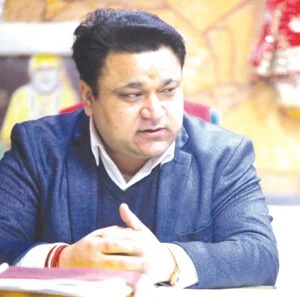
By Shivang Satya Gupta
There is a particular cruelty in betrayal that uses the language of education. A bomb at a school gate is an act of violence everyone can see and name. But a book, approved by a committee of “experts,” stamped with a Government of India scheme’s logo, and slipped quietly onto a school library shelf — that is a different kind of attack. It is slower, quieter, and aimed precisely at the age group least equipped to defend itself: children.
That is what the Jammu Kashmir Peoples Forum has documented in its report, India’s Money, Against India, released on 30 June 2026. The report is not a political pamphlet. It is a methodical, evidence-led account of how a book titled Personalities and Legends of J&K, Series 4 — authored by Hilal Ahmad and Santosh Meena, published by Oberoi Book Service, and procured under the Samagra Shiksha scheme of the Government of India — was placed in government school libraries across the Union Territory of Jammu and Kashmir for the academic year 2025-26. The book, as the JKPF report demonstrates paragraph by paragraph, teaches children that a convicted terrorist is a martyr, that India is an “occupier and oppressive state,” and that an “armed revolution” against the Indian nation remains an unfinished mission.
This is not a matter of editorial opinion. These phrases appear verbatim in the book. They were approved by an official committee. They were paid for by Indian taxpayers.
The Book and What It Tells Children
The chapter on Maqbool Bhat opens with the heading “SHAHEED MAQBOOL BHAT.” Shaheed means martyr. Maqbool Bhat was convicted of murder by an Indian court, had his death sentence restored by the Supreme Court of India in 1978, and was hanged at Tihar Jail on 11 February 1984. The book records these facts, then immediately pivots to call him “one of the greatest revolutionaries of modern Kashmiri history.” It goes further: it tells children that his hanging was carried out “in haste to avenge the killing of an Indian diplomat,” that he is remembered as Shaheed-e-Azam — the greatest martyr — and that the “armed revolution” he began “is not going to be brushed under the carpet until his mission is complete.”
In the same chapter, Jammu and Kashmir is referred to not as Jammu and Kashmir — not as the Union Territory of India it constitutionally is — but as “IOK” and “IHK”: Indian Occupied Kashmir, Indian Held Kashmir. These are Pakistan’s terms. They encode a territorial claim Pakistan has never been able to enforce militarily or diplomatically. A state-funded Indian schoolbook adopted them as standard usage.
The book also includes sympathetic profiles of Masarat Alam Bhat, currently lodged in Tihar Jail on National Investigation Agency charges, whose organisation was banned as an unlawful association in December 2023; Syed Ali Shah Geelani, who openly advocated Kashmir’s merger with Pakistan and whose Tehreek-e-Hurriyat was banned; Shabir Shah, whose Jammu and Kashmir Democratic Freedom Party was declared unlawful in October 2023; and Mirwaiz Umar Farooq, whose Awami Action Committee was declared unlawful in March 2025. The JKPF report notes, clinically and with citations, that the book reproduces the positions of these figures “approvingly and without rebuttal.”
None of this is a matter of contested interpretation. The legal record of each of these figures — the detentions, the NIA chargesheets, the UAPA bans — is a matter of public record. The book placed them alongside genuine achievers of the valley as “great personalities” and “legends.” An official committee of experts certified the result as “age-appropriate” motivational reading.
How It Got There: The Structural Failure
The Samagra Shiksha scheme, launched in 2018, is among the most important education programmes the Government of India runs. It is centrally sponsored, substantially funded from the Union budget, and implemented through State and UT implementation societies. Its purpose is to improve the quality of school education from pre-primary to Class 12 across the country. It is, in every meaningful sense, India’s investment in the next generation.
For Jammu and Kashmir, the stakes of that investment are not merely educational. After the revocation of Article 370 in August 2019 and the subsequent reorganisation of J&K as a Union Territory, the integration of J&K’s schools into the national educational mainstream was understood to be a long-term civilisational project — one that would, over years and decades, weave the valley’s children more firmly into the fabric of the Indian nation. The scheme was meant to be an instrument of that integration.
Instead, an expression of interest was floated, 364 publishers submitted 463 books, four expert sub-committees examined them, and Personalities and Legends of J&K, Series 4 — a book that calls India an occupier and glorifies a hanged terrorist — was recommended, certified, procured, and distributed. The book reached school libraries in June 2026.
The question the JKPF report asks is one that cannot be deflected with bureaucratic language: who read this book before certifying it?
The Government’s Response: Swift, But Questions Remain
To its credit, the J&K administration moved quickly once the scandal broke on July 3, 2026, Commissioner Secretary Ram Niwas Sharma confirmed that the book had been withdrawn from all schools with immediate effect. The following day, the School Education Department issued Government Order No. 257-JK(Edu) of 2026, suspending eight education officials — including the Coordinator Library and Assistant Coordinator of Samagra Shiksha, a Principal, four Lecturers, and an Academic Officer. A contractual Computer Assistant was disengaged with immediate effect. The authors and publishers of the two books involved were banned and blacklisted across the Union Territory of J&K. An IAS officer, Ashwani Kumar, Financial Commissioner (Additional Chief Secretary), Power Development Department, was appointed as the Inquiry Officer with a 30-day deadline to submit a report.
Leader of Opposition Sunil Sharma had raised the matter in a press conference, demanding immediate withdrawal, a high-level probe, and action against those responsible. The government’s response followed within hours.
These are not trivial steps. Suspensions at this level, blacklisting of publishers, an IAS-led inquiry with a fixed deadline — these signal that the administration recognises the gravity of what occurred. But two things must be said plainly.
First, the withdrawal and the suspensions are the beginning of accountability, not the end of it. The JKPF report identifies a chain of responsibility: the authors, the publisher, the approving expert committee, the Education Minister, and the Chief Minister. Eight officials have been suspended. The composition and identity of the expert committee that certified this book as “age-appropriate” has not yet been made public. The minutes of that committee’s deliberations have not been released. The total public funds spent on printing and distributing the book have not been disclosed. Until those questions are answered, the probe is incomplete.
Second, the speed of the government’s withdrawal — the book was supplied in June 2026 and pulled on July 3, barely weeks later — itself raises an uncomfortable question. The book did not become anti-national on July 3. It was anti-national when it was written, when it was submitted by the publisher, when the committee reviewed it, when it was certified, when it was procured, and when it was placed on a shelf for a child to read. The government acted when the controversy became public. The question India deserves an answer to is: why did the system not catch it before?
The Double Standard the JKPF Report Names
The JKPF’s most pointed observation is about equivalence under law. If an individual were to post on social media content calling India an “occupier and oppressive state,” honouring Maqbool Bhat as a Shaheed-e-Azam, or approvingly quoting leaders who chanted “Kashmir Banega Pakistan,” the outcome would be predictable: a takedown notice, a possible account suspension, and in all likelihood, an FIR under the Unlawful Activities (Prevention) Act.
The same content, printed on paper, stamped with a Government of India scheme’s imprint, and distributed to government school libraries, passed through a committee of experts.
This is not a rhetorical point. It is a structural one. The UAPA does not contain an exemption for scheme-funded publications. The Constitution of India does not have a carve-out for content that reaches children through official procurement channels rather than private WhatsApp forwards. Either the content is lawful or it is not. If it would attract legal action in a private post, the question of whether it attracts equivalent scrutiny in a government-funded book is one that the inquiry officer, and ultimately the courts, must answer.
What This Demands — Beyond the Immediate
The immediate demands are clear and the government has partially met them: withdrawal of the book, suspension of officials, appointment of an inquiry officer. What must follow is harder.
The entire Samagra Shiksha library procurement chain in J&K must be audited — not just for Series 4 of this publication, but for every book procured in the 2025-26 cycle and, if necessary, in previous cycles. The JKPF report notes that 463 books from 364 publishers were selected. The question is not whether the other 461 books are also problematic. The question is whether the committee’s review process was rigorous enough to answer that with confidence. If it certified this book as “age-appropriate,” the default position must be that it cannot be trusted to have reviewed others adequately.
The composition of the expert sub-committees must be made public. Anonymity in appointment processes is a legitimate governance tool. Anonymity for officials who certify anti-national content for school libraries is not a governance tool; it is a shield. The identity of those who read this book and approved it is material to the inquiry.
Action under the Bharatiya Nyaya Sanhita, 2023, and the UAPA must be considered in respect of the authors and the publisher. The JKPF report is explicit: glorifying a proscribed movement, honouring a terrorist executed under the Supreme Court’s judgment, and asserting India’s occupier status in a government-funded publication are not merely grounds for administrative embarrassment. They may be grounds for criminal accountability. That determination belongs to investigators and prosecutors, but the inquiry must not stop at the administrative level.
And finally, Chief Minister Omar Abdullah and Education Minister Sakina Itoo — who was, notably, unavailable for comment when the story broke — must account for the governance environment that permitted this. The JKPF report asks a simple and devastatingly direct question: how can children be taught to treat a money launderer, a habitual offender, a pro-Pakistani separatist, known to work under the direction of foreign and external anti-India elements, as a great personality? That question deserves a direct answer, not a press release.
The Larger Stakes
It would be a mistake to read this episode as a J&K-specific problem that a few suspensions will resolve. It is, at its core, a test of whether India’s institutions — its education bureaucracies, its expert committees, its scheme implementation mechanisms — are robust enough to protect the state’s own investment in its future.
Jammu and Kashmir has paid a price, over decades, that most of India has never been asked to pay. Its soldiers died. Its Pandits fled. Its economy was strangled by a conflict sustained in no small part by exactly the ideology this book propagates. The people of the valley — Kashmiri and Dogra, Muslim and Hindu, Gujjar and Bakarwal — have lived inside that conflict. What they were promised, after 2019, was integration: not of the coercive kind, but of the institutional kind. Schools that teach the same curriculum. Libraries that offer the same books. A future where a child in Sopore and a child in Jammu are equally part of India.
A book on a Sopore school library shelf that calls India an occupier is not integration. It is the opposite.
The JKPF report is a public service. It documented what the system missed, named what the system approved, and forced a response that the system would not have generated on its own. That is what civil society is for.
The government pulled the book. Now it must pull the thread — all the way to the end.