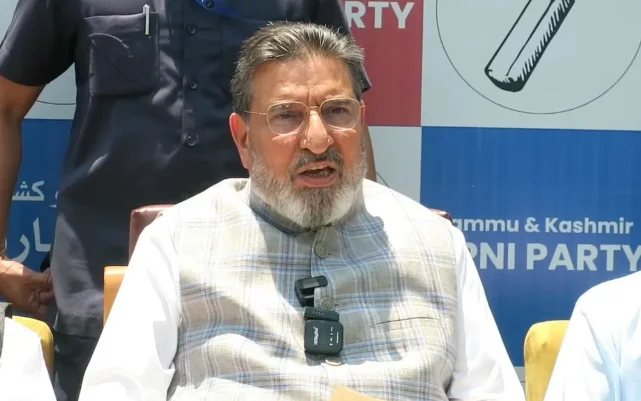
Jammu, Sep 16 : Apni Party president Altaf Bukhari on Wednesday said the restoration of statehood to Jammu and Kashmir would require sustained dialogue and persuasion with the Centre, rather than confrontation.
Asked about the roadmap that the government should adopt for it, Bukhari said, "There is only one way forward on the restoration of statehood, and that is dialogue. There is no other way."
Opposing the path of confrontation, he said, "J-K has seen enough confrontation since 1947. You have to convince, you have an argument. It may not be easy, but Delhi has to be convinced and we have an argument."
Bukhari referred to the historical status of Jammu and Kashmir, saying, "We are a 200-year-old state."
He also referred to the recent mobilisation in Ladakh and said that the people of Jammu and Kashmir could similarly make their collective voice heard.
"If two-and-a-half lakh people in Ladakh can make their voice heard, perhaps these 13 million people of Jammu and Kashmir can also do so if we show courage," he told reporters here.
"But since we have mortgaged ourselves to political parties, what argument will we make? Those parties are merely passing their time," he said.
He questioned the priorities of the proposed all-party meeting being held ahead of the Assembly session, particularly in the backdrop of ongoing protests by medical employees and MBBS interns.
"Is anything significant going to come out of this meeting? This all-party meeting is being held before the Assembly session. They will discuss how the salaries of legislators will be increased. Tell me, how will their salaries be increased?" he said.
Bukhari questioned why similar attention was not being given to the demands of NHM employees and medical interns protesting for an increase in their internship allowance.
At the same time, Bukhari said his opposition to the government did not mean support for any undemocratic attempt to remove it.
"The last gift of democracy that the Government of India has given us is an elected government. Therefore, we do not want anyone to interfere with it. If this government has to go, the people will remove it," he said.
"We will oppose it every day and leave no stone unturned in doing so, because we are doing it for the people. But that does not mean that it should be removed through undemocratic means," Bukhari said.
Bukhari said there is a need for a wider debate on caste-based legislation and reservation policies, including whether benefits should continue to accrue to the same families or be provided at the entry point.
"Wherever bills are made and implemented on the basis of caste, I think after 76 years, we need to examine who should be brought where and at what stage," he said.
"Take reservation, for instance. Should we continue giving reservation to one family, give it to one person in a family, or provide reservation at the entry point? This is a very broad subject," Bukhari said, adding that he would elaborate on the issue at an appropriate seminar or discussion.