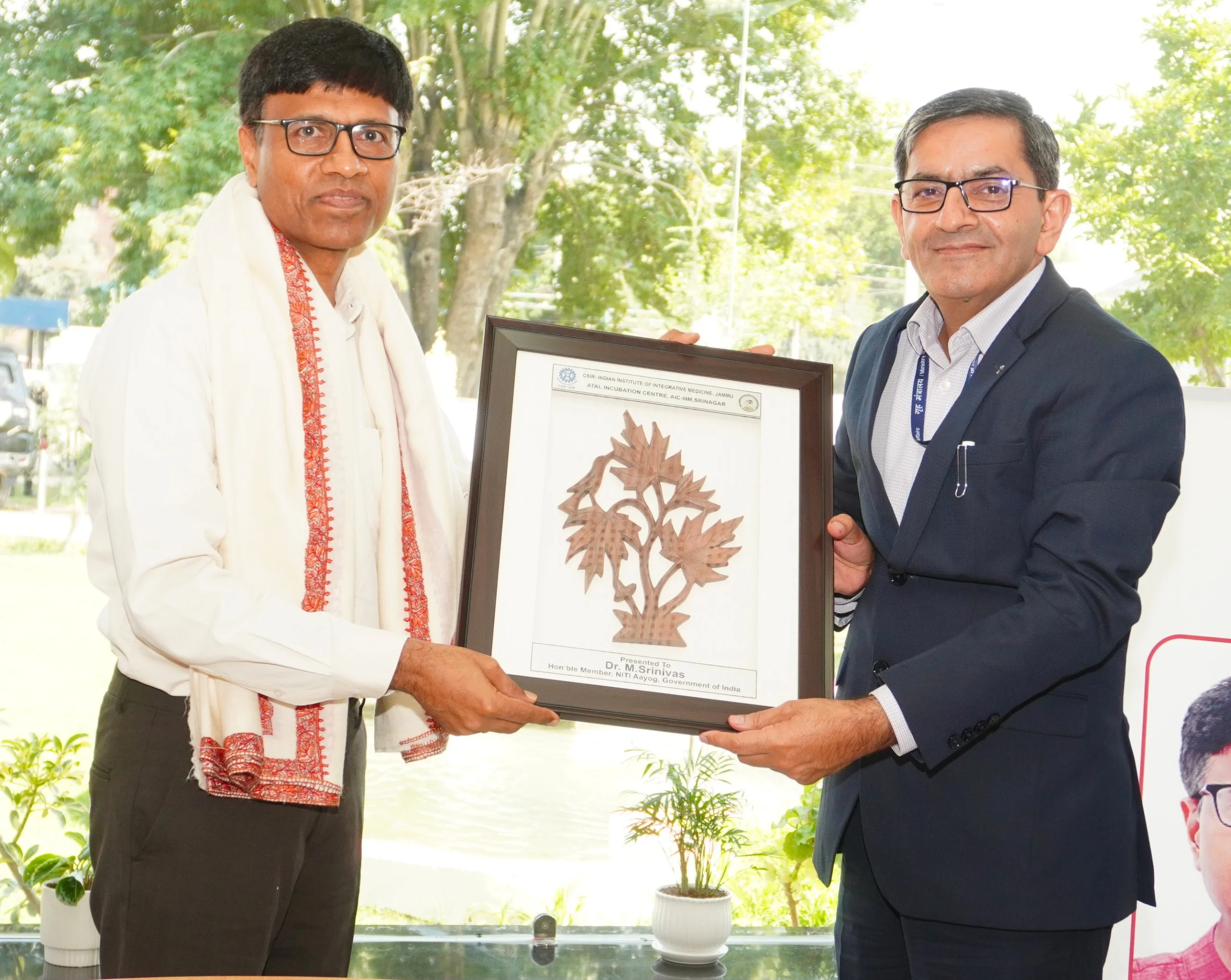
SRINAGAR: Hon’ble Member, NITI Aayog, Dr. M. Srinivas visited the CSIR-Indian Institute of Integrative Medicine (CSIR-IIIM), Srinagar, on Friday and reviewed the institute’s work in scientific research, innovation, entrepreneurship and societal initiatives in Jammu and Kashmir.
Accompanying Dr. Srinivas were Shri Subhash Chandra Meena, Economic Adviser, NITI Aayog; Dr. Muniraju S.B., Deputy Adviser, NITI Aayog; and Sumaya Yousuf, Program Lead, Atal Innovation Mission (AIM).
The dignitaries interacted with scientists, scholars, officials and startups and reviewed various science-led initiatives being undertaken by CSIR-IIIM and its innovation ecosystem.
During the visit, Dr. Srinivas also visited the AIC-IIIM Bioinnovation Foundation, the Atal Incubation Centre at CSIR-IIIM’s Srinagar Branch, and reviewed its incubation and entrepreneurship activities.
The AIC-IIIM ecosystem is aimed at supporting innovators and startups by providing incubation, mentorship, institutional support and opportunities for technology development and enterprise creation.
Dr. Srinivas also highlighted the critical challenges involved in translating research on phytochemicals and medicinal plants into safe, effective and commercially viable products.
He emphasised the need for stronger scientific validation, collaboration with clinicians and other stakeholders, and a clear pathway from basic research and toxicity studies to clinical applications and eventual commercialisation.
He said the institute was already taking important steps in this direction through its incubation ecosystem and added that NITI Aayog would facilitate greater connectivity and collaboration wherever required.
Dr. Srinivas noted that the existing incubation facilities at the institute provided an opportunity for young innovators and entrepreneurs to develop their ideas with mentorship and institutional support and translate them into ventures with wider social impact.
Dr. Srinivas also interacted with startups incubated at AIC-IIIM and reviewed their work in areas including wellness, medicines, healthcare and other emerging applications.
He appreciated the efforts of young entrepreneurs in translating scientific ideas into innovative products and solutions and encouraged them to further strengthen their research, technology and market linkages.
During his interaction with scholars and young researchers, Dr. Srinivas encouraged them to make the best use of the scientific ecosystem and opportunities available at CSIR-IIIM.
He said researchers working in areas such as agriculture, phytochemicals, nutraceuticals, medicinal and aromatic plants had access to a unique range of opportunities and should recognise the importance of their work.
He urged young scientists not to limit their focus to publications, citation indices and conventional academic parameters alone, but also consider the wider social impact of their research.
Dr. Srinivas said researchers should examine how their scientific work could contribute to solving real-world problems, improving healthcare, addressing societal challenges and benefiting humanity.
He emphasised the importance of collaboration between basic scientists, clinicians and other stakeholders to ensure that scientific discoveries move towards practical applications.
Highlighting CSIR-IIIM’s work in biodiversity and plant sciences, he said the institute’s activities in areas such as gene banking, conservation of endangered plants, phytochemicals and nutraceuticals were of immense importance.
Dr. Zabeer Ahmed also apprised Dr. Srinivas of some of the critical challenges being faced by the institute in advancing research on cannabis and other phytochemical-based interventions.
He highlighted the need for timely research permissions as well as the availability of adequate scheduled facilities in India for phytopharmaceutical drug manufacturing, which can pose challenges in taking promising research outcomes towards clinical translation and commercialisation.
Responding to the issues raised, Dr. Srinivas assured that the challenges related to science, technology and innovation would be examined and addressed at the appropriate level.
Dr. Zabeer Ahmed said addressing these challenges would be important for strengthening the science, technology and innovation ecosystem and facilitating the translation of research into practical applications.