
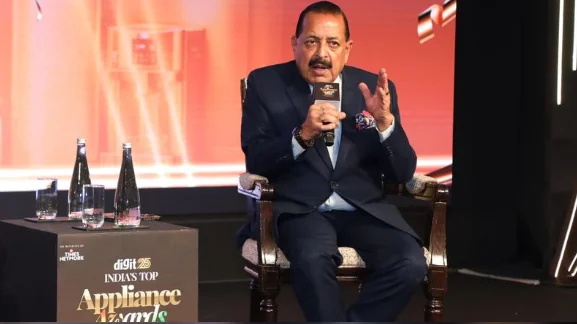
New Delhi, Aug 9: India is poised to play a key role in the next industrial revolution, which is expected to be driven largely by artificial intelligence and biotechnology, Union Minister Dr Jitendra Singh said on Sunday.
Addressing a media conclave attended by technology developers, industry leaders and other stakeholders, Singh said India had been relatively late in participating in the previous, IT-driven industrial revolution but was now well positioned to lead in emerging technologies.
He said India was among the few countries to have a dedicated biotechnology policy, BioE3, besides initiatives such as the National Quantum Mission and India AI Mission.
Singh said India’s space economy, which was once negligible, had grown to around USD 9 billion and was projected to reach USD 40-45 billion over the next eight to nine years.
He said India’s technological capabilities had undergone a major transformation and the country was now competing against global benchmarks in several frontier areas.
Referring to the Chandrayaan missions, Singh said India’s space programme had contributed to global scientific knowledge, including evidence related to water molecules on the Moon.
He said India had never lacked talent or scientific capability, but an enabling policy environment was necessary to convert these strengths into tangible outcomes.
The minister said the global economy was gradually shifting towards biotechnology, artificial intelligence, circular economy, recycling and other technology-intensive sectors alongside traditional manufacturing.
He said biotechnology would increasingly influence healthcare, agriculture and food production while creating new opportunities for employment and economic growth.
Singh also highlighted the opening of India’s space sector to private participation in 2020, saying the move had demonstrated how policy reforms could unlock domestic capabilities.
He cited the emergence of Indian space start-ups, including companies developing rockets and achieving unicorn status, as examples of the transformation.
The minister said the Government was also opening sectors that were traditionally dominated by the public sector, including nuclear energy, to greater private participation.
He called on Indian industry to prepare for emerging opportunities and develop the capabilities required to participate in these sectors.
Singh said India had limited time to prepare for the country’s 2047 development vision and stressed that every sector would need to evolve to strengthen India’s position globally.
He also highlighted the role of technology in expanding access to education, particularly for students from smaller towns and financially weaker backgrounds.
The minister said India’s start-up ecosystem was no longer confined to major metropolitan centres, with young entrepreneurs increasingly emerging from smaller cities and towns.
Singh also referred to government efforts to simplify governance by removing outdated laws and procedures. He said nearly 2,000 obsolete laws had been repealed as part of these reforms.
He cited changes related to family pension rights, women’s nomination rights and pension provisions for government employees, along with the removal of the requirement for gazetted officer attestation for several documents.
Singh said India’s ambition for 2047 required the country to move beyond being a follower and develop capabilities and innovations that could be adopted globally.
He called for stronger cooperation between the government and private sector, saying both sides needed to learn from each other and work together.
A “whole of government plus whole of nation” approach, he said, would be essential to achieve India’s long-term technological, economic and developmental goals.