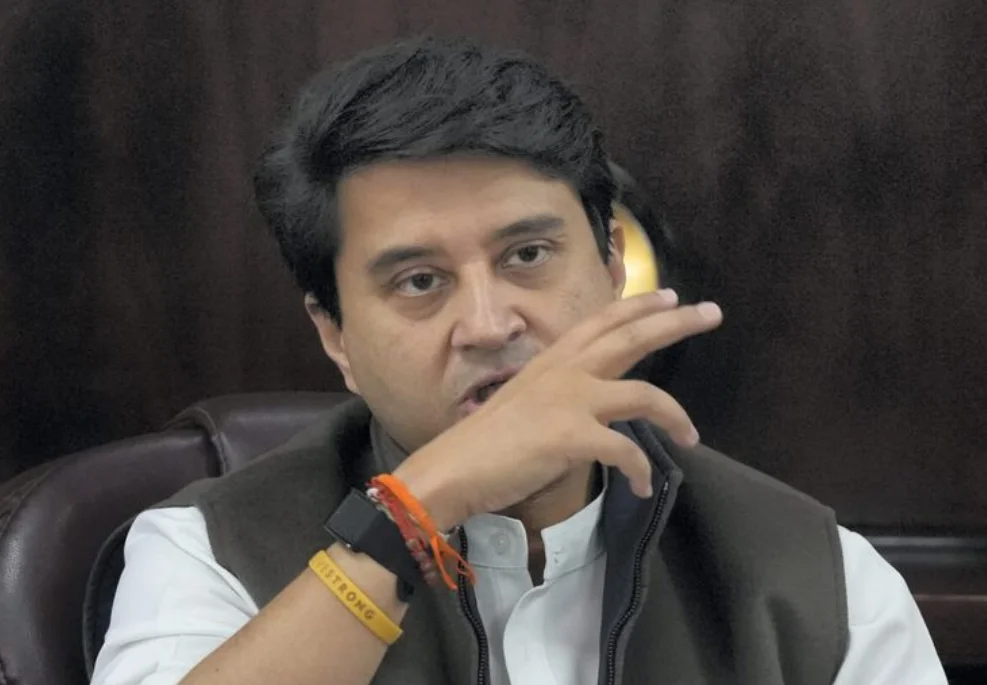
New Delhi, October 9: Union Communications Minister Jyotiraditya Scindia on Friday asserted that India does not permit monopolies in any sector, stressing that satellite communication (satcom) companies can begin operations only after meeting all prescribed security requirements and regulatory conditions.
Speaking at the India Mobile Congress, Scindia said the Department of Telecommunications follows a technology-neutral approach and aims to provide consumers with a wide range of services and choices in a competitive market.
He said three companies—Elon Musk's Starlink, Reliance Jio's satellite communication venture Jio Satcom, and Bharti-backed Eutelsat OneWeb—have already received satcom licences. These companies will be permitted to commence operations after individually fulfilling the required security conditions and other regulatory milestones.
Amazon's satellite internet venture, Project Kuiper, has also expressed interest in entering the Indian market and will have to follow the established licensing procedure.
Scindia said the government would ensure a fair and competitive environment, allowing consumers to choose their preferred service provider without favouring any particular company.
The minister's remarks come amid a controversy over Starlink's proposed satellite internet services in India. Musk has alleged that certain influential business interests are attempting to prevent Starlink's entry into the market to protect their dominance.
Scindia clarified that licensed companies would receive the necessary spectrum once the government finalises the revenue-based pricing mechanism. He added that the Telecom Regulatory Authority of India (TRAI) and the Department of Telecommunications were nearing a decision on the pricing framework for satellite spectrum.
The dispute intensified after the government rejected allegations that Starlink was being deliberately blocked by domestic business groups. The telecom ministry maintained that India's authorisation framework for telecommunications and satellite services was fair, non-discriminatory and applicable equally to all companies.
Musk subsequently questioned whether Reliance Industries Chairman Mukesh Ambani wielded undue influence over India's market, asking on social media whether “Ambani is the real boss of India”.
The SpaceX founder also claimed that Starlink, which he said was licensed in more than 165 countries, had spent years complying with Indian government requirements but was still awaiting permission to begin services.
Responding to the political debate surrounding the issue, Scindia criticised the Congress party, saying its position on the matter appeared inconsistent. He referred to the party's earlier objections regarding the granting of a licence and its subsequent criticism over Starlink's inability to launch operations.
The controversy highlights the growing competition in India's satellite internet sector, where global and domestic companies are seeking to expand connectivity, particularly in remote and underserved regions.
The government has maintained that security compliance, spectrum allocation and regulatory approvals remain essential prerequisites for all satellite communication providers before commercial operations can begin.