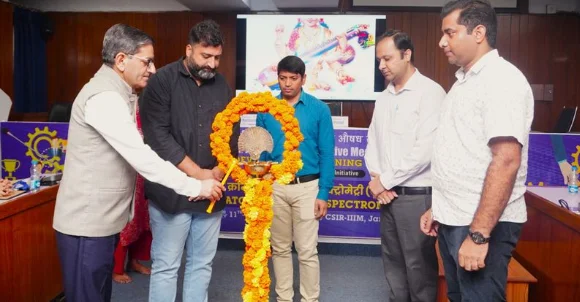
JAMMU, Aug 11: CSIR-Indian Institute of Integrative Medicine (CSIR-IIIM), Jammu, on Tuesday commenced the second phase of a three-day Skill Development Programme (SDP) on Gas Chromatography-Mass Spectrometry (GC-MS) under the CSIR-Integrated Skill Initiative.
The programme is aimed at providing students, researchers and young professionals with hands-on training in advanced analytical techniques, instrumentation, sample preparation, method development, data analysis and troubleshooting.
Addressing the inaugural session, Dr Zabeer Ahmed, Director, CSIR-IIIM Jammu and CSIR-NBRI Lucknow, welcomed the participants and highlighted the institute’s wider contribution to society through scientific research, skill development, farmer support, startup incubation and collaboration with government and industry.
He said the GC-MS programme was among several initiatives undertaken by CSIR-IIIM to equip students, scholars and young professionals with practical, job-oriented skills relevant to research and industry.
Dr Ahmed highlighted the institute’s focus on drug discovery and development, particularly the modernisation and scientific validation of traditional Indian systems of medicine. He said CSIR-IIIM’s research covers the entire pre-clinical drug discovery process, from bioprospection of medicinal sources and natural resources to extraction, characterisation, isolation and biological evaluation.
He noted that the institute’s research includes studies related to cancer, metabolic disorders and other diseases, besides toxicological and allied investigations.
Dr Ahmed also emphasised CSIR-IIIM’s role in employment-oriented skill development, stating that the institute conducts both short-term and long-term programmes designed to enhance participants’ practical capabilities. He said trainees from earlier programmes had secured placements in CSIR laboratories and various industries.
Highlighting the institute’s support to the farming community, he referred to the CSIR Aroma Mission and Purple Revolution, under which scientific interventions have encouraged farmers in the region to adopt aromatic crops and develop successful cultivation practices.
Dr Ahmed further said CSIR-IIIM was supporting startups through incubation facilities at its Jammu and Kashmir centres and technology park. He encouraged young innovators to utilise the institute’s laboratory and incubation infrastructure to validate and develop their ideas.
He also highlighted CSIR-IIIM’s collaboration with government agencies in scientific policymaking and infrastructure development, including biotech-related initiatives in Jammu and Kashmir.
Earlier, Dr Nasir-ul-Rasheed, Nodal, Skill Development, welcomed the participants and said the institute’s skill development initiatives had expanded from short three-day programmes to long-term courses lasting three to six months.
He said CSIR-IIIM Jammu was among the early CSIR laboratories to introduce several job-oriented courses covering quality control and HPLC, gas chromatography, API synthesis, medicinal chemistry, CGMP-based non-sterile formulation operations and laboratory technician training.
Dr Nasir said the first batch of long-term skill development trainees achieved 100 per cent placement, while the second batch is scheduled to appear for interviews with multinational companies and other industries.
Giving an overview of the GC-MS programme, Dr Nagaraju Nekkala, Scientist-C, CSIR-IIIM Jammu, said participants would receive comprehensive training in GC-MS principles, instrumentation, sample preparation, method development, data analysis and troubleshooting.
The three-day programme, being held from August 11 to 13, combines classroom lectures, laboratory orientation and practical training. Participants will be introduced to advanced analytical facilities housing instruments such as GC-MS, LC-MS, NMR and HPLC.
The practical sessions will include essential oil analysis by GC-MS, covering sample preparation, analysis, peak identification and interpretation of analytical data. Participants will also receive training in pesticide residue analysis and related analytical procedures.
Dr Maqsood Ahmed, Scientist-D, CSIR-IIIM Jammu, provided an overview of the institute’s Quality Management and Instrumentation (QMI) Division, which provides analytical and instrumentation support to research groups, industries and startups.
He said the division comprises the Central Instrumentation Facility, Quality Control and Quality Assurance facility, and CGMP facility, with sophisticated instruments including NMR, GC-MS and HPLC.
The programme is designed to provide participants with practical exposure to GC-MS, a widely used analytical technique in pharmaceuticals, natural products, food analysis, environmental studies, research and industrial applications.
The inaugural session concluded with a vote of thanks by Dr Vikas C. Roy, Technical Officer, CSIR-IIIM Jammu.