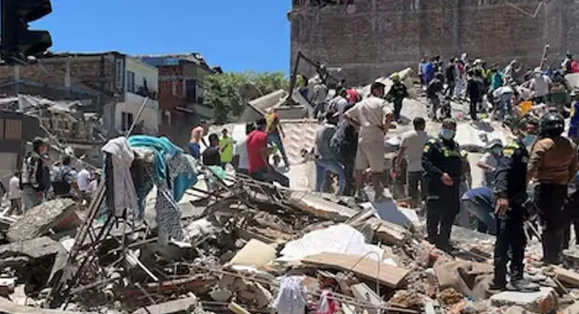
Bogota, Aug 12 : The death toll from the devastating 7.4-magnitude earthquake that struck Colombia has risen to at least 213, with authorities warning that the figure could increase as search and rescue teams continue combing through collapsed structures for survivors.
Emergency crews are working round the clock to clear rubble and debris following the powerful quake, which struck the mountainous Choco region near San Jose del Palmar and sent strong tremors across western Colombia, including the capital Bogota.
Cali has reported the highest number of fatalities, with 95 deaths, followed by Pereira with 66. Another 38 people were killed in other parts of Valle del Cauca, excluding Cali, while nine deaths were reported in Quibdo and five in Manizales.
Cali and Pereira remain among the worst-affected areas, with several structures collapsing and people feared trapped under debris, according to the Colombian Association of Capital Cities.
Authorities in Bogota and Medellin, the country's two largest cities, have not reported major damage but continue to inspect buildings and infrastructure for possible impact.
Rescue operations have been complicated by the remote location of the epicentre in Choco, where limited road connectivity could hamper the movement of emergency teams and delay assistance to more than half a million residents.
Pereira and Manizales, located around 100 km from the epicentre, have also suffered extensive damage, with around 5,000 buildings reportedly affected.
Colombian President Abelardo de la Espriella, who was inaugurated on Friday, declared a state of national disaster as countries and international leaders offered support for relief and rescue operations.
The scale of the destruction has renewed concerns over Colombia's preparedness for major earthquakes. The country is highly vulnerable to seismic activity because it lies along the Pacific Ring of Fire and at the convergence of three tectonic plates.
Geologists have called for stronger preparedness measures, including updated land-use maps and improved geological surveys to strengthen seismic regulations and reduce risks.
Flover Rodriguez, a geologist and director of the Colombian Association of Energy Geologists and Geophysicists, said Colombia needed a clear land-use policy aimed at protecting communities from seismic hazards.
The association had also urged the government in late July to improve geological mapping and expressed concern over the absence of a centralised database showing which municipalities had conducted basic geological studies. Such information could help authorities better prepare for earthquakes, landslides and floods.
John Londono of the Colombian Geological Service said earthquake-resistant construction regulations for new buildings had improved, but many older structures still failed to meet required safety standards.
He particularly warned that a large number of low-income and social housing units did not comply with earthquake-resistance requirements, leaving vulnerable communities at greater risk.
Civil engineer and seismology professor Gina Villalobos also pointed to shortcomings in construction practices, saying that some projects fail to follow approved designs and safety standards in an effort to save time or reduce costs.
Rescue and assessment operations remain underway, with authorities continuing to search damaged areas and assess the full extent of casualties and destruction.