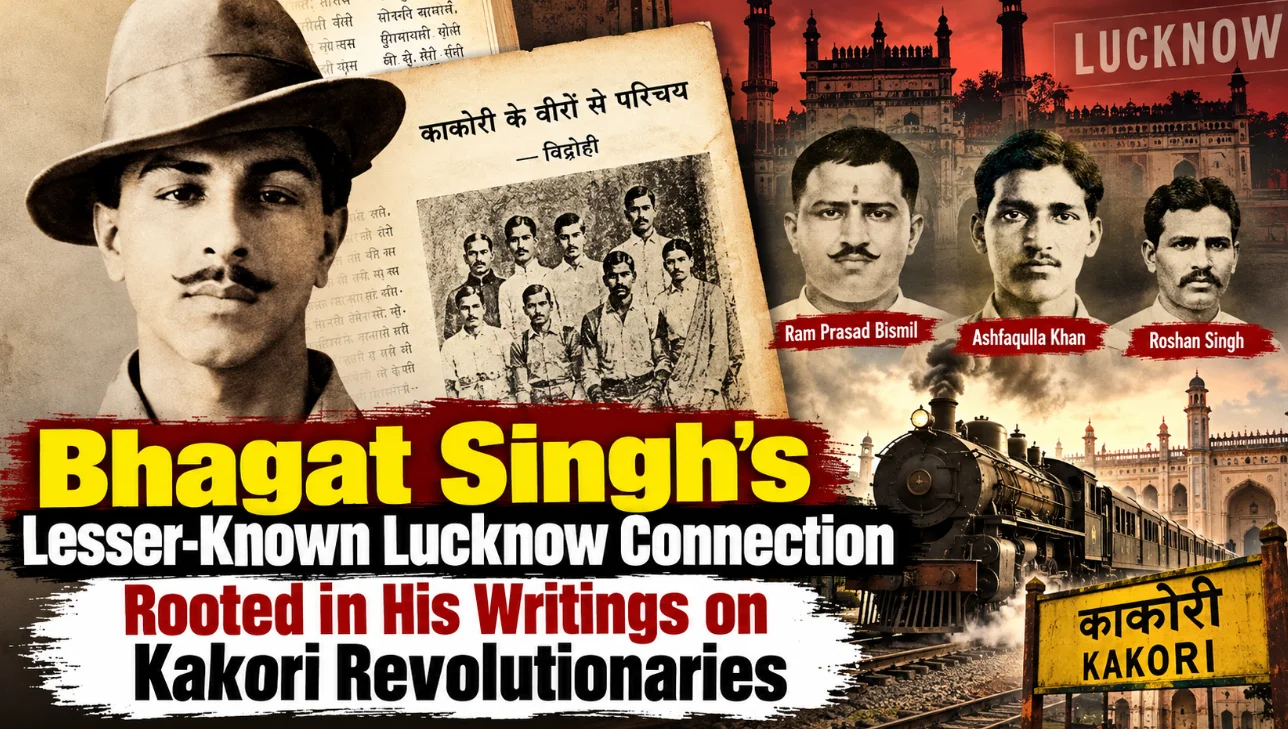
LUCKNOW, SEPTEMBER 29 : Bhagat Singh is widely remembered as one of India’s most prominent revolutionaries, who was executed at the age of 23. However, a lesser-known chapter of his life has a strong connection with Lucknow through the Kakori train action and his writings on the revolutionaries involved in the case.
The connection has gained renewed attention around Bhagat Singh’s birth anniversary on September 28, with Lucknow-based Dastangoi artists Pragya Sharma and Himanshu Bajpai preparing a special Dastan on the revolutionary leader.
On August 9, 1925, Ram Prasad Bismil, Ashfaqulla Khan and their associates stopped a train near Kakori, close to Lucknow, and seized government treasury funds to support their revolutionary activities. Most of those involved were later arrested, while Chandrashekhar Azad managed to evade arrest.
Bhagat Singh was living in Kanpur at the time and was already associated with the Hindustan Republican Party. The crackdown following the Kakori incident became an important phase in his political and revolutionary development. He was not yet 18.
In May 1927, Bhagat Singh, writing under the pseudonym ‘Vidrohi’, published an article in Punjabi titled ‘Kakori Ke Veeron Se Parichay’, or An Introduction to the Heroes of Kakori. The article is included in Bhagat Singh Ke Poorn Dastavez, edited by Chaman Lal.
In the article, Bhagat Singh described the trial and fate of the Kakori revolutionaries with deep admiration. He recalled their conduct when the verdict was announced and highlighted their courage, sacrifice and strong bonds with one another.
He also recorded the sentences handed down to the accused, including death sentences for three revolutionaries and various terms of imprisonment for others.
Bhagat Singh particularly remembered the final moments of the revolutionaries as they prepared to part ways. He highlighted Ram Prasad Bismil’s farewell and reflected on the sacrifices made by those involved in the Kakori case.
Towards the end of his article, Bhagat Singh criticised the indifference of people outside prison and urged society to recognise the suffering and sacrifices of those who had devoted their lives to the freedom struggle.
The article was published under the name ‘Vidrohi’. According to an editorial note in the collection of his writings, Bhagat Singh was arrested soon after its publication. The well-known photograph of him sitting handcuffed on a charpoy was also taken during this period.
According to Pragya Sharma, Bhagat Singh was already associated with the revolutionary organisation when the Kakori crackdown took place. Himanshu Bajpai said his connection with the Kakori episode went beyond political activity, extending into writing and documenting the lives and sacrifices of its revolutionaries.
The forthcoming Dastan on Bhagat Singh is scheduled to premiere in Lucknow on December 19, the martyrdom day of Ram Prasad Bismil, Ashfaqulla Khan and Roshan Singh, who were executed on December 19, 1927.
The production is part of Sharma and Bajpai’s wider work of bringing stories from India’s freedom movement to audiences through Dastangoi performances.
The Lucknow connection explored in their upcoming presentation, however, is rooted in Bhagat Singh’s own engagement with the Kakori revolutionaries — an episode he observed, studied and wrote about while his own revolutionary ideas were taking shape.